The evidence
Three perspectives on the same data.
The March 2026 Outcome Governance Benchmark is published as three artifacts. Each one shows a different cut of the result. All three are ungated.
The open standard for outcome governance
Outcome System Result (OSR) is the causal architecture governing what accumulates after agents act. Five tiers. One primary outcome.
Read the benchmark evidence →Not AI Governance. AI Governance governs the system. Outcome Governance governs the result.
See the difference →The central claim
Twelve AI agent frameworks tested across three LLM families. Every governed framework graded A or B. Every ungoverned framework graded F. Model choice didn't change the result. The causal information architecture did.
See the benchmark →The evidence
The March 2026 Outcome Governance Benchmark is published as three artifacts. Each one shows a different cut of the result. All three are ungated.
The standard
OSR is a causal architecture that accumulates outcomes instead of just targeting them. Each tier answers a different question about how work turns into value. Every tier is causally connected to the one above it.
The external change the system exists to create.
The few system levers that move key stocks and pace progress toward the Primary Outcome.
Guardrails and quality gates that verify system health before advancing.
The tempo of change. Inflows, outflows, and backflows with explicit thresholds.
Dated, owned, verifiable deliverables that unblock flows or prove a gate has been met.
The book
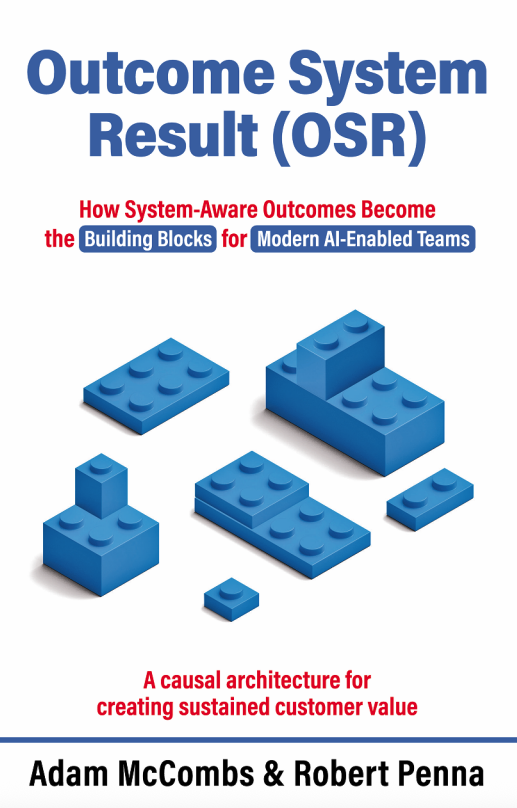
Outcome System Result by Adam McCombs and Robert Penna. Five hundred pages, fourteen chapters. The foundational reference for the OSR standard, used by teams operationalizing outcome governance across modern industries.
Endorsements from leaders putting OSR into practice.
"Adam equips product leaders with an essential framework to cut through the noise: to define, track, and understand what really matters in building a business."
"Most goal-setting books tell you what to track. Adam tells you why outcomes actually happen, and once you see the difference, you can't unsee it."
"Most strategy leaders today are still chasing customer-focused metrics that look clean on a dashboard but miss what customers actually experience, and that DCV/ECV gap only widens once AI agents start acting inside the workflow. If you're deploying agentic systems to drive business outcomes, this book is essential. Agents need a causal architecture to act against, and OSR is the first framework I've seen that gives them one."
The comparison
OKRs ask whether teams hit the target. OSR asks whether the system produced the outcome and whether that outcome holds.
| Dimension | OKR | OSR |
|---|---|---|
| Core purpose | Set targets and measure progress | Design and steer the system that produces sustained outcomes |
| Causality | Often implied | Explicit causal architecture |
| System state | Not modeled | Modeled through Support Outcomes |
| What success means | Hit or miss the target | Outcome accumulates and holds |
| Time horizon | Quarterly cadence | Continuous with phase protocols |
Who's using it
OSR is being operationalized across modern industries. Teams in SaaS, services, and nonprofit operations are using the standard to govern what their agents and systems accumulate.
For practitioners
The book gives you the map. Practitioners need the tooling. PathFwd is the commercial path, built on the OSR standard, with verified outcomes and the Supervisor API for agent governance.
Explore PathFwd →

